The Black Parade

The Black Parade era is the bands most well known era, second after Revenge. The era surrounding this album is known for it's black and white colour scheme, dark themes and the fact that the album is considered by most one of the most influential albums to the emo music genre.
Aesthetic
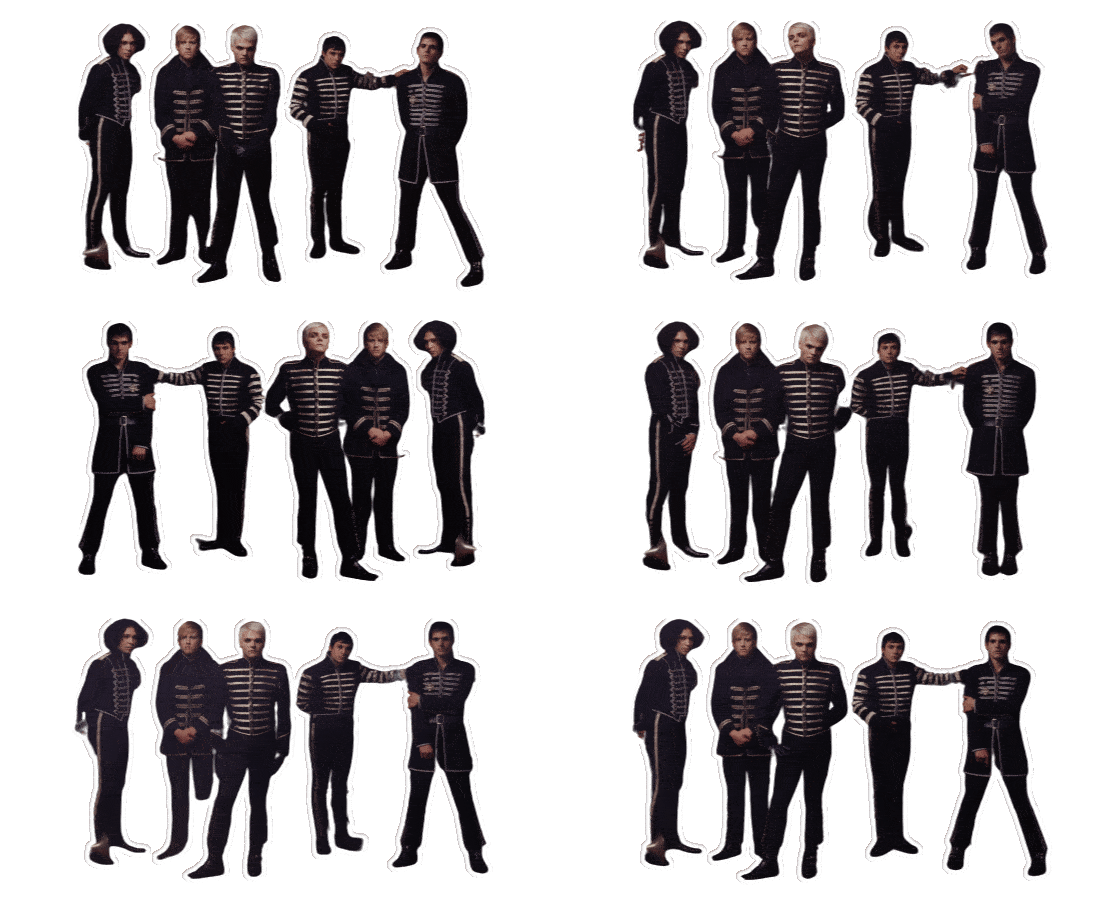
The aesthetic of this era was heavily focused on dark themes, matching the dark idea of the concept album. The band members each had their own black and white marching band outfits, and Gerard dyed his hair a stark silver and cut it short. The live shows during this era were heavily theatrical, matching the idea of the album.
Click images to see them larger


Album

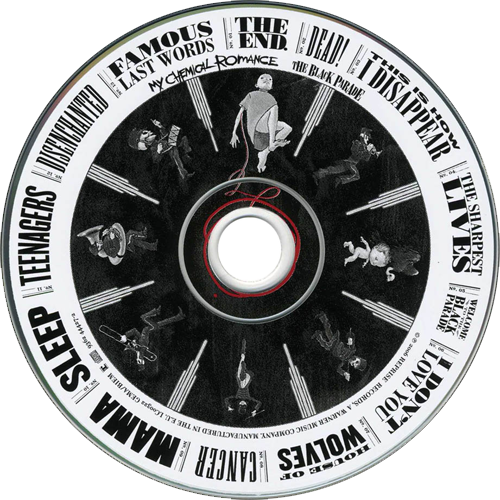
The Black Parade is My Chem's third studio album, released on the 23rd of October, 2006. This album went on to become My Chem's most defining work, making a huge dent in the emo scene. It was recorded during the period between April to August 2006, and during those months, most of the album was written and recorded while the band isolated themselves in the Paramour Mansion.
This album went on to be certified as 4x platinum in the U.S, 3x platinum in the U.K, and gold in both Argentina and Chile.
Track Listing:
- The End
- Dead!
- This Is How I Disappear
- The Sharpest Lives
- Welcome To The Black Parade
- I Don't Love You
- House of Wolves
- Cancer
- Mama (featuring Liza Minnelli)
- Sleep
- Teenagers
- Disenchanted
- Famous Last Words
- Blood (hidden track; not avaliable on all editions)
Japanese Edition:
- Heaven Help Us
- Welcome To The Black Parade (music video)
iTunes Deluxe Edition
- My Way Home Is Through You
- Kill All Your Friends
- Heaven Help Us
- Welcome To The Black Parade (music video)
- Teenagers (music video)
- Famous Last Words (music video)
- My Chemical Romance Welcomes You to the Black Parade
There is also a 10th anniversary edition of the album, titled The Black Parade/Living With Ghosts, released on September 23, 2016, with 11 previously unreleased demo tracks.
Album cover image
People Involved In The Album
Band Members
- Bob Bryar - Drums, percussion
- Frank Iero - Guitars, backing vocals
- Ray Toro - Guitars, backing vocals, and bass guitar on 'Cancer'
- Gerard Way - Lead and backing vocals
- Mikey Way - Bass guitar (except on 'Cancer')
Additional Musicians
- David Campbell - String and horn arrangements
- Rob Cavallo - Acoustic piano
- Cheech Iero - Additional percussion on 'Welcome To The Black Parade'
- Linda Iero, Donald James and Donna Lee Way - Additional vocals on 'Mama'
- Liza Minnelli - Guest vocals on 'Mama' as 'Mother War'
- Jamie Muhoberac - Hammond B3 organ, synthesizer, Wurlitzer electronic piano, acoustic piano on 'Blood'
Technical
- Rob Cavallo - Producer
- My Chemical Romance - Producers
- Doug McKean - Engineer
- Chris Steffen - Engineer (El Dorado)
- Jimmy Hoyson - Engineer (Capitol)
- Jon Herroon - Assistant Engineer
- Chris Lord-Alge - Mixing
- Keith Armstrong - Assistant Engineer
- Ted Jenson - Mastering
- Lars Fox - Additional Pro Tools
- Andrew "Hans" Busher - Guitar Technician
- Tyler Dragness - Guitar Technician
- Mike "Sack" Fasano - Drum Technician
- Chris Anthony - Photography
- Matt Taylor - Additional Photography on Limited Edition, art direction, design
- Gerard Way - Additional Photography on Limited Edition, art direction
- Ray Toro - Additional Photography on Limited Edition
- Ellen Wakayama - Art direction
- James Jean - Illustrations
Outside Influences
The most well known influence to the album is the band's experience in the Paramour Mansion. During the recording of the album, the band resided in the mansion, and while they were there, they experienced many things, including mental health hardships for all of the members, but especially Mikey Way, who eventually was forced to leave the manor due to this.
Other influences include David Bowie's The Rise And Fall Of Ziggy Stardust And The Spiders From Mars and Pink Floyd's 1979 album The Wall.
Gerard said that “There's a degree of contempt in some of the lyrics on this record, and a degree of resignation. This record is like The Wall in that it's about alienation - alienation of a band, and then the claiming of one's destiny."
References
- Wikipedia Contributors. The Black Parade [Internet]. Wikipedia. Wikimedia Foundation; 2019 [cited 2026 Mar 14]. Available from: https://en.wikipedia.org/wiki/The_Black_Parade
- Ashley. My Chemical Romance’s Black Parade at LA’s Haunted Paramour Estate [Internet]. Curious Archive. 2023 [cited 2026 Mar 22]. Available from: https://www.curiousarchive.com/black-parade-my-chemical-romance-paramour/
- Bryant T. Not the life it seems : the true lives of My Chemical Romance. New York: Da Capo Press; 2014.
- Elliott P. “This record is like The Wall. It’s about the alienation of a band, and then claiming one’s destiny”: How My Chemical Romance channelled the spirit of Pink Floyd to create a classic concept album [Internet]. MusicRadar. 2025 [cited 2026 Apr 10]. Available from: https://www.musicradar.com/artists/this-record-is-like-the-wall-its-about-the-alienation-of-a-band-and-then-claiming-ones-destiny-how-my-chemical-romance-channelled-the-spirit-of-pink-floyd-to-create-a-classic-concept-album
- cassiewhitt. My Chemical Romance’s “The Black Parade”: 13 Facts Superfans Know [Internet]. Loudwire. [cited 2026 Apr 10]. Available from: https://loudwire.com/my-chemical-romance-black-parade-facts/